JetBrains State of PHP 2025: Laravel Leads PHP Frameworks — What It Means in 2026
JetBrains’ State of PHP 2025 paints a very specific picture of where PHP (and Laravel) is heading as we enter 2026: PHP is not “dying” — it’s professionalizing. The ecosystem is modernizing, tooling i...
Quick answer: JetBrains’ State of PHP 2025 shows Laravel remains the dominant PHP framework, leading at ~64% usage with no major framework shake-ups.
In this guide, you’ll get the top 5 takeaways and what they mean for 2026 planning:
- which PHP/tooling direction teams are moving toward
- what to prioritize (testing, performance, DX)
- how to turn survey signals into your next sprint decisions
If you’re running Laravel in production, this is the fastest way to align roadmap + hiring + upgrades with real ecosystem data.
JetBrains’ State of PHP 2025 paints a very specific picture of where PHP (and Laravel) is heading as we enter 2026: PHP is not “dying” — it’s professionalizing. The ecosystem is modernizing, tooling is maturing fast, and AI is becoming a default part of day-to-day development workflows.
For Laravel teams, that translates into a clear set of strategic priorities for 2026:
- standardize on modern PHP versions (and align framework upgrades with support windows),
- invest in automated code quality + testing,
- decide how you’ll operationalize AI safely,
- and keep an eye on runtime/deployment innovation (FrankenPHP is moving from “interesting” to “real”).
Below is a practical, Laravel-team-focused breakdown of the report’s most important findings — and what you should do about them in 2026.
If your Laravel stack is heading into 2026 with an upgrade backlog or performance concerns, our team can help you modernize safely—framework upgrades, CI hardening, and production-grade architecture via our Laravel development services. For ongoing stability (security patches, uptime, speed), pair it with a monthly maintenance & monitoring plan.
1) The survey signals stability (and it’s mostly experienced teams)
JetBrains’ PHP findings come from their Developer Ecosystem Survey 2025, with 1,720 respondents who identified PHP as their main language.
The broader JetBrains survey ran April–June 2025 and included 24,534 developers after data cleaning, with weighting applied (and an explicit note that JetBrains users may be more likely to respond).
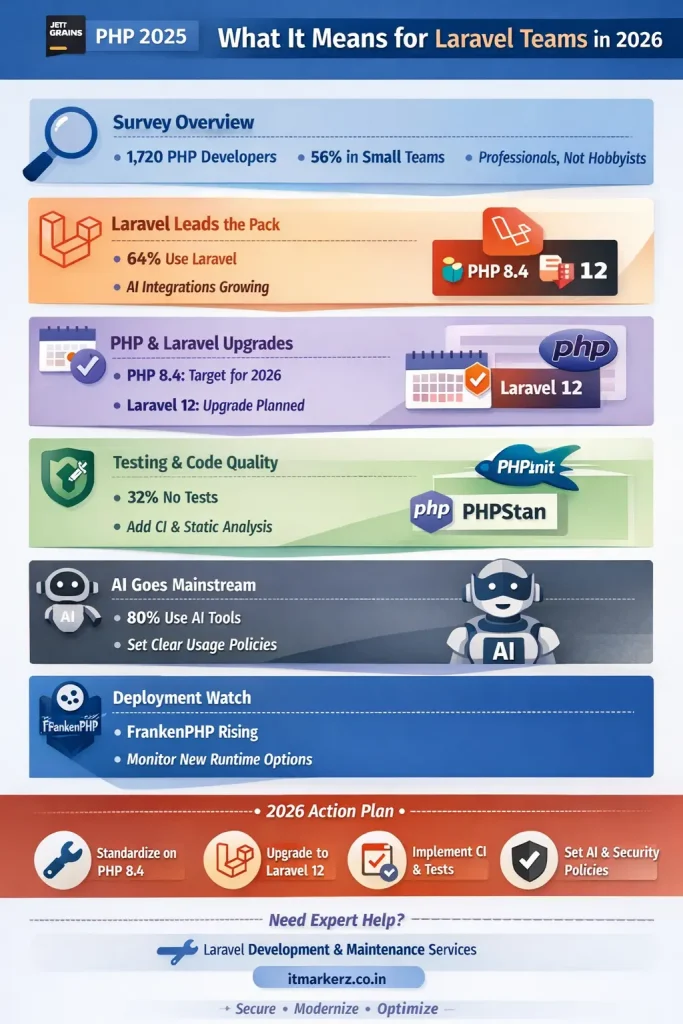
Why Laravel teams should care: this isn’t just “hobby PHP” — the data is skewed toward professional teams and real workflows. The report also notes 56% of PHP developers work in small teams (2–7 people), which matches how many Laravel shops operate.
What this means in 2026: you don’t need heavyweight “enterprise process” to improve outcomes — you need lightweight automation (tests, static analysis, CI) that fits small teams.
2) Laravel remains the dominant PHP framework — and its ecosystem is accelerating
There were “no major shifts” in framework adoption: Laravel leads with 64% usage among PHP developers in the survey.
JetBrains also includes a Laravel ecosystem note from Taylor Otwell pointing to Laravel Cloud and AI-related integrations like Laravel Boost and “MCP”.
What this means in 2026: Laravel’s center of gravity is moving toward:
- more “platform” thinking (deployment/ops via Laravel Cloud),
- more first-party or standardized tooling integrations,
- more AI-assisted developer experience.
If you’re running Laravel in 2026 and still treating it like “just a PHP framework”, you’ll miss the speed gains that the ecosystem is trying to hand you.
3) PHP version reality: modernization is winning — but 2026 is a support-window trap
JetBrains reports PHP 8.x dominates with 89% usage, while PHP 7.x is still present (and legacy versions aren’t totally gone).
Now pair that with PHP’s official support timeline:
- PHP 8.3 active support ended Dec 31, 2025 (security fixes continue after that).
- PHP 8.4 remains in active support through Dec 31, 2026.
So as of January 2026, if your production baseline is PHP 8.3, you’re already in “security-fixes-only” territory. That’s not a crisis — but it is a strategic signal: 8.4 becomes the sensible default for 2026 for teams that want active support.
Laravel version alignment (this is the key planning lever)
Laravel’s own support policy table (official docs) makes planning much easier:
- Laravel 11: supports PHP 8.2–8.4; security fixes until March 12, 2026.
- Laravel 12: supports PHP 8.2–8.5; security fixes until Feb 24, 2027.
- Laravel 13: planned Q1 2026, supports PHP 8.3–8.5 (per the same table).
What this means in 2026 (practical guidance):
- If you’re on Laravel 10 or older, you’re already behind on framework security windows — prioritize upgrading.
- If you’re on Laravel 11, plan to move to Laravel 12 in 2026 to extend runway (and target PHP 8.4+ where possible).
treat PHP + Laravel upgrades as a planned release cycle—not an emergency. If you want a staged, low-risk upgrade plan (audit → compatibility fixes → test coverage → CI rollout → deployment hardening), we offer this as part of our Laravel development services, and we can keep your app secure and fast long-term with our laravel maintenance & monitoring.
4) Testing: PHP is improving — but a big chunk still ships without tests
JetBrains reports:
- PHPUnit remains the standard at 50%,
- Pest reached 17% (gaining momentum),
- and 32% of developers don’t write tests at all.
For Laravel teams, this is a big deal because the “Laravel advantage” is largely speed of change. If your team moves fast but has low test coverage, you’ll eventually pay for it with regressions, slow releases, and high support load.
What to do in 2026 (high ROI, low drama):
- Pick a baseline: PHPUnit-only is fine; Pest is also fine — the point is consistency.
- Make it measurable: a simple rule like “new features require tests” + CI gating beats a perfect testing strategy that never happens.
5) Code quality is moving toward static analysis — but many teams still do nothing
JetBrains highlights a clear leader: PHPStan at 36% usage (up significantly), with tools like PHP CS Fixer (30%) and PHP_CodeSniffer (22%) also widely used — while 42% don’t use any code quality tools regularly.
For Laravel teams in 2026, static analysis is not “nice to have” anymore. It’s the cheapest way to reduce bugs when:
- team size is small,
- change velocity is high,
- and AI-generated code is increasingly common.
What to do in 2026:
- Make PHPStan (or equivalent) part of CI.
- Add style checks that are automated (don’t rely on humans to remember rules).
6) AI is now default — your team needs policy, not debate
This is the loudest shift in the report:
- 95% of developers have tried at least one AI tool.
- 80% regularly use AI assistants/editors.
- Daily usage leaders: ChatGPT (49%), GitHub Copilot (29%), JetBrains AI Assistant (20%) (and JetBrains AI tripled adoption vs last year).
The bigger “2026 signal” is what’s next:
- 72% are likely to try AI coding agents in the next year.
- JetBrains points to their agent Junie as part of that shift.
- Top blockers are not technical — they’re governance: privacy/security (44%), IP concerns (24%), and lack of knowledge (22%).
What Laravel teams should do in 2026
If you do nothing, AI use will still happen — just inconsistently and unsafely. A simple policy beats chaos. Examples of what to standardize:
- What’s allowed: refactors, boilerplate tests, scaffolding, docs, query optimization suggestions.
- What’s restricted: pasting secrets, customer data, proprietary code in public tools.
- How to review: require human review for AI-generated code (especially auth, payments, permissions, billing).
7) Deployment & runtime innovation: FrankenPHP is getting real attention
JetBrains calls out FrankenPHP as a 2025 ecosystem highlight and notes it became a project backed by the PHP Foundation, plus it has “worker mode” and performance-oriented features.
This matters for Laravel teams because deployment options shape cost/performance — and Laravel itself now documents FrankenPHP as a server configuration option in its deployment docs.
What to do in 2026:
- You don’t have to migrate production to FrankenPHP immediately.
- But you should track it, test it in a non-critical service, and evaluate if it changes your scaling/cost profile.
A practical “2026 action plan” for Laravel teams
| 2025 finding | 2026 risk for Laravel teams | Action to take |
|---|---|---|
| PHP 8.x dominates, but support windows move fast | Running on “security-only” branches without realizing it | Standardize on PHP 8.4 for 2026 where possible; align Laravel version accordingly |
| Laravel leads framework adoption | Teams fall behind on ecosystem leverage (platform + tooling) | Treat Laravel upgrades as a strategic cadence, not a painful event |
| 32% don’t write tests | Shipping speed collapses as codebase grows | Add CI test gating + minimum coverage expectations |
| PHPStan rising, but many teams still skip code quality | More bugs + slower reviews, especially with AI code | Add static analysis + formatting checks to CI |
| AI is mainstream; agents next | IP/security exposure + inconsistent quality | Write a short AI usage policy + enforce review rules |
The bottom line for 2026
JetBrains’ State of PHP 2025 is essentially telling Laravel teams: the winners in 2026 won’t be the teams who argue about whether PHP is modern — they’ll be the teams who operationalize modernization.
That means:
- stay inside support windows (PHP + Laravel),
- automate quality (tests + static analysis),
- and put guardrails around AI so it speeds you up instead of creating risk.
If you’re planning a Laravel upgrade in 2026—or want to standardize testing, PHPStan, CI, and secure AI usage—we can do the heavy lifting end-to-end. Explore our Laravel development services for upgrades and new builds, and our laravel maintenance & monitoring plan for ongoing security, performance, and uptime.

Binu Mathew
CEO @ itmarkerz technologies
Binu Mathew
CEO @ itmarkerz technologies
Reading Progress
In this article
10 sectionsWeekly Digest
Curated tech insights
Get the latest articles and tutorials delivered directly to your inbox.
No spam. Unsubscribe anytime.
