Laravel Testing Strategy (2026): Pest/PHPUnit + CI Checklist
If your Laravel app is growing, testing isn’t “nice to have”—it’s what lets you ship faster without breaking production. This guide gives you a practical testing strategy (not theory) you can implemen...

If your Laravel app is growing, testing isn’t “nice to have”—it’s what lets you ship faster without breaking production. This guide gives you a practical testing strategy (not theory) you can implement in a week and improve every sprint.
Quick answer
A strong Laravel testing strategy in 2026 means:
- Feature tests for critical flows (auth, billing, permissions, APIs)
- Unit tests for business logic (services, pricing rules, policies)
- Fakes for external systems (HTTP, queues, notifications, storage)
- Repeatable CI pipeline (tests + lint + static analysis)
- Stable test data (factories + minimal seeds)
1) The testing pyramid that actually works in Laravel
Think in layers:
- Unit tests (fastest): Pure business rules (calculations, validators, service classes)
- Feature tests (most valuable): HTTP endpoints, middleware, auth, validation, database writes
- E2E tests (few only): A tiny set for “login → checkout → success” style flows
Rule: Start by covering the top 5 revenue / risk flows with feature tests. Then expand unit tests around complex logic.
2) PHPUnit vs Pest: what we recommend in 2026
Laravel supports both. The best choice depends on your team’s style:
- If your team prefers clean, readable tests: use Pest
- If your codebase is PHPUnit-heavy: keep PHPUnit and modernize gradually
Either way, keep assertions consistent and avoid mixing styles everywhere.
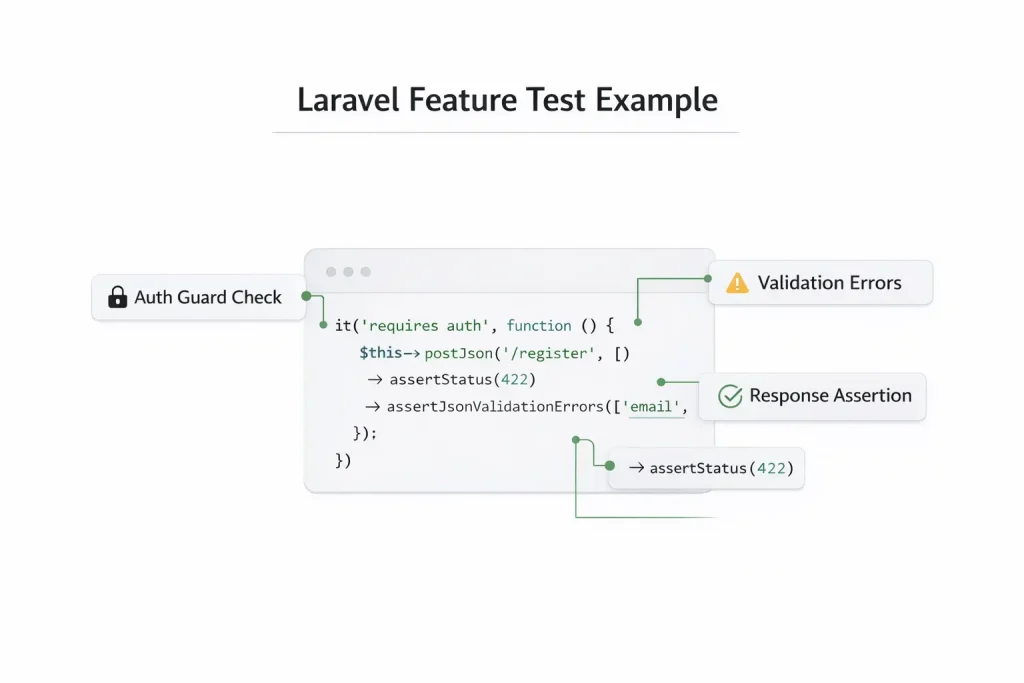
Example (Pest feature test)
use App\Models\User;

it('requires auth to access dashboard', function () {
    $this->get('/dashboard')->assertRedirect('/login');
});

it('shows dashboard for authenticated users', function () {
    $user = User::factory()->create();

    $this->actingAs($user)
        ->get('/dashboard')
        ->assertOk()
        ->assertSee('Dashboard');
});
3) Set up a stable test environment (the biggest win)
Most teams don’t “lack tests”—they lack stable tests. Do this once and you’ll save weeks:
- Create
.env.testing - Choose a test database strategy:
- MySQL/Postgres in CI (closest to production)
- SQLite for speed (good early, but may diverge in edge cases)
- Ensure migrations + factories are reliable
Recommended Laravel defaults:
- Use
RefreshDatabasefor most feature tests - Prefer factories over heavy seeds
use Illuminate\Foundation\Testing\RefreshDatabase;

uses(RefreshDatabase::class);
Run tests fast locally:
php artisan test
php artisan test --parallel
4) Write feature tests for the flows that matter
Start with flows where a bug costs money or trust:
- Signup / Login / OTP
- Subscription purchase / billing
- Admin permissions
- File uploads / downloads
- API endpoints (mobile/web)
Feature test pattern (validation + response)
it('validates required fields on registration', function () {
    $this->postJson('/register', [])
        ->assertStatus(422)
        ->assertJsonValidationErrors(['email', 'password']);
});
Tip: Always assert HTTP status, JSON shape/message, and database changes (only when relevant).
5) Use Laravel fakes to avoid flaky tests
External dependencies make tests slow and flaky. Laravel provides clean fakes.
HTTP fake
use Illuminate\Support\Facades\Http;

Http::fake([
    'api.partner.com/*' => Http::response(['ok' => true], 200),
]);
Queue / Events / Mail / Notifications / Storage fakes
Queue::fake();
Event::fake();
Mail::fake();
Notification::fake();
Storage::fake('public');

Queue::assertPushed(\App\Jobs\SendInvoiceJob::class);
6) Testing APIs: the “API-first” baseline
If you want stable mobile/web APIs, enforce consistency in error format, pagination, auth guards, and rate limiting behavior.
it('returns paginated data in expected structure', function () {
    $this->getJson('/api/v1/products')
        ->assertOk()
        ->assertJsonStructure([
            'data',
            'links' => ['first','last','prev','next'],
            'meta'  => ['current_page','last_page','per_page','total'],
        ]);
});
7) CI pipeline checklist (ship with confidence)
The goal: every PR runs the same quality gate.
Minimum CI checks
- ✅
php artisan test - ✅ Lint/format (Laravel Pint)
- ✅ Static analysis (PHPStan/Larastan)
- ✅ (Optional) coverage threshold for critical folders
Example GitHub Actions workflow (simple)
name: CI

on: [push, pull_request]

jobs:
  tests:
    runs-on: ubuntu-latest
    steps:
      - uses: actions/checkout@v4
      - uses: shivammathur/setup-php@v2
        with:
          php-version: '8.3'
          coverage: none
      - run: composer install --no-interaction --prefer-dist
      - run: cp .env.example .env
      - run: php artisan key:generate
      - run: php artisan test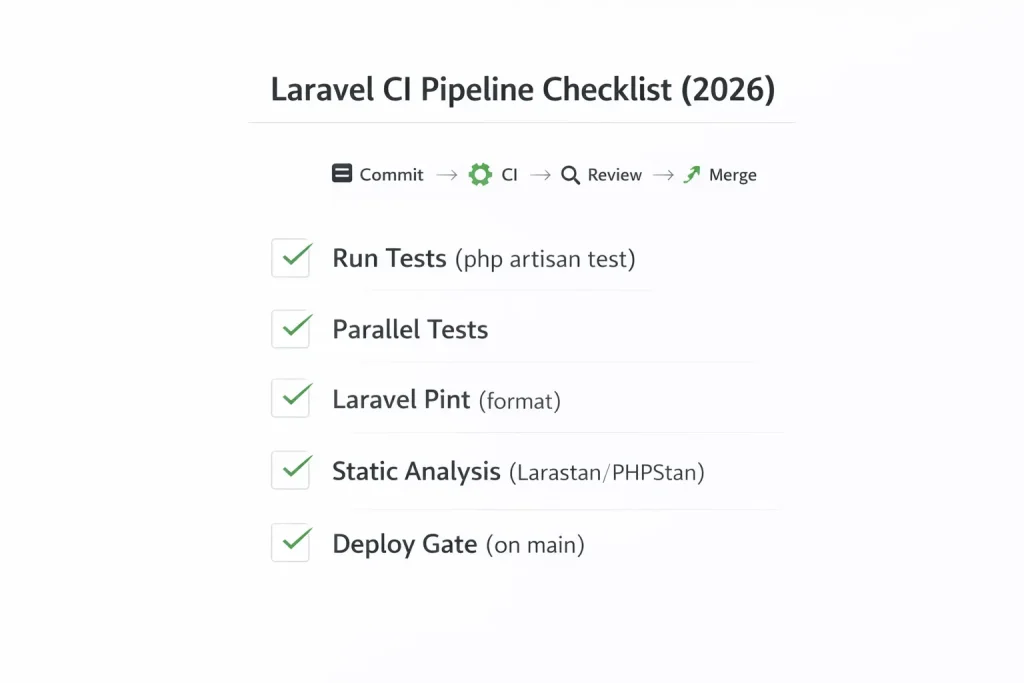
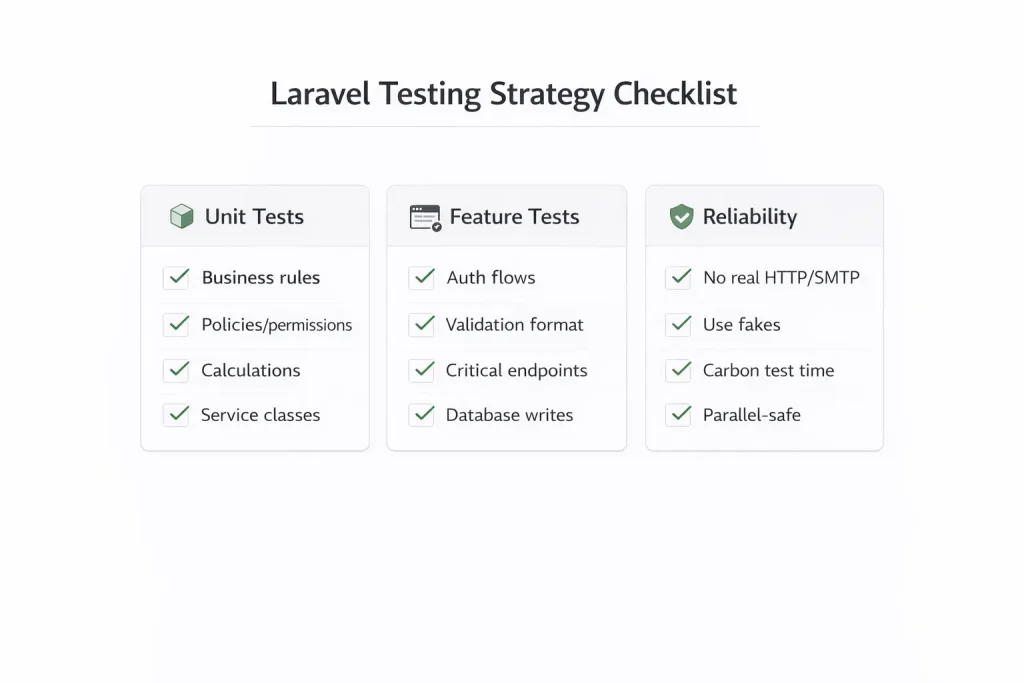
8) The testing checklist we use for Laravel delivery
- Unit tests
- [ ] All pricing/calculation logic tested
- [ ] Policy/permission logic tested
- [ ] Any complex parser/mapper tested
- Feature tests
- [ ] Auth (success + failure)
- [ ] Validation errors return correct format
- [ ] Critical endpoints protected by middleware
- [ ] Database writes verified for core flows
- Reliability
- [ ] No tests depend on real HTTP/SMTP
- [ ] Time-based logic uses
Carbon::setTestNow() - [ ] Parallel tests pass
9) Common mistakes (and quick fixes)
- Flaky tests: remove real external calls → use fakes
- Slow suite: reduce heavy seeds, prefer factories
- Random failures: stop relying on record order; assert by IDs/fields
- SQLite surprises: match production DB for critical flows in CI
Need a Laravel testing baseline quickly?
If you already have a Laravel app but almost no tests, the fastest path is:
- Add tests for top 5 flows
- Add CI gate
- Refactor safely after baseline is green
Want us to set up a production-grade testing baseline and CI for your Laravel app? Visit our Laravel Development Service.
Related: enterprise Laravel architecture blueprint.
FAQ
1) How many tests do I need to start?
Start with 10–20 feature tests for critical flows. That alone reduces production bugs massively.
2) Is 100% coverage required?
No. Focus coverage on risk areas: billing, auth, permissions, and critical APIs.
3) Pest or PHPUnit?
Both are fine. Pest is faster to write and read; PHPUnit is more traditional.
4) Should I use SQLite for tests?
SQLite is fast, but for critical apps, run CI on the same DB engine as production.
5) What’s the fastest way to add tests to a legacy app?
Begin with feature tests around the most-used endpoints, then extract business logic into services and unit test those.
Laravel Development Resources

Binu Mathew
CEO @ itmarkerz technologies
In this article
13 sectionsScroll to see all 13 sections
Weekly Digest
Curated tech insights
Get the latest articles and tutorials delivered directly to your inbox.
No spam. Unsubscribe anytime.