Service-business websites
What a cleaning-company website needs to get quotes
A cleaning website has one job: get a visitor from “I need this cleaned” to a quote request, on a phone, in a couple of minutes. It needs a page for each service, clear areas, one repeated action and a lead that reaches you. Here is how that looks on two sites we built.
By itmarkerz Technologies. Updated 30 October 2026.
Two real sites, two different buyers
We built both of these on Next.js, set up their Google Business Profile, Analytics and Search Console, and continue to work on their local SEO. They are public, so you can open them beside this page. We can’t share their lead numbers or rankings, so nothing below claims how many quotes either one gets. This is about how they are put together and why.
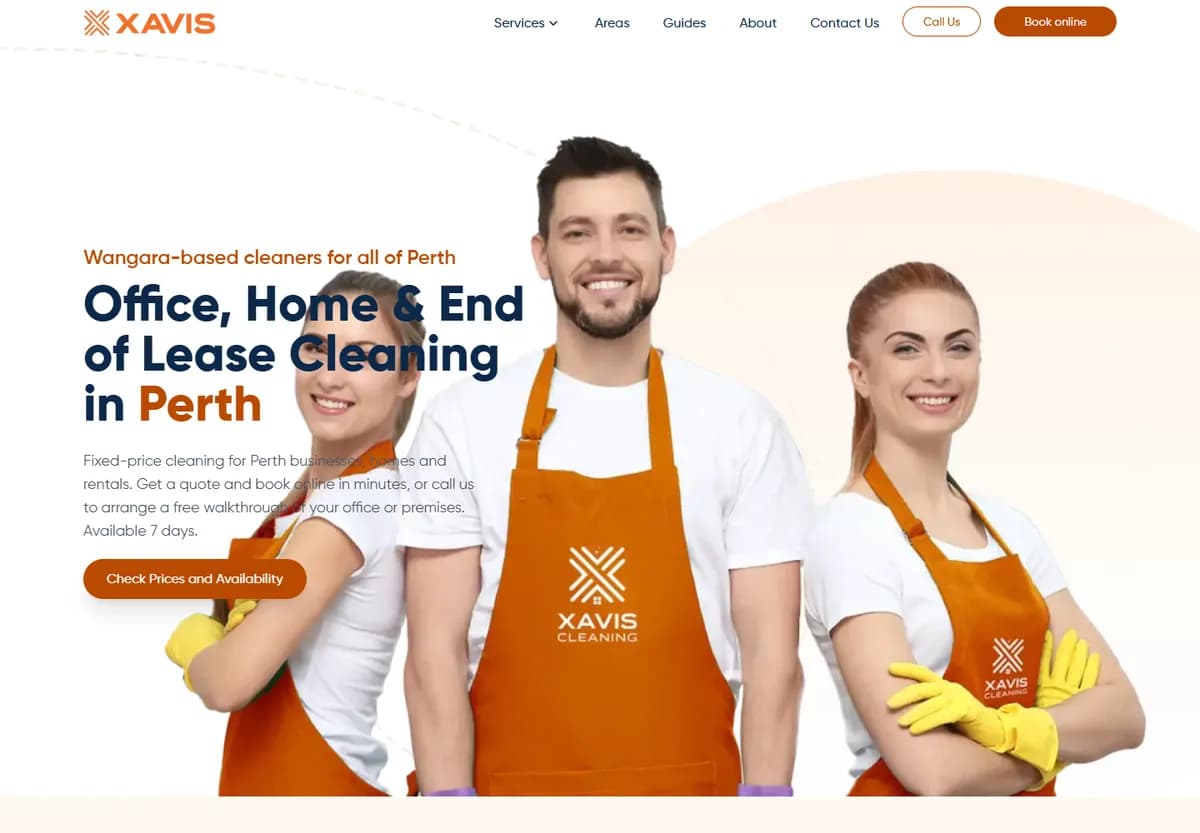
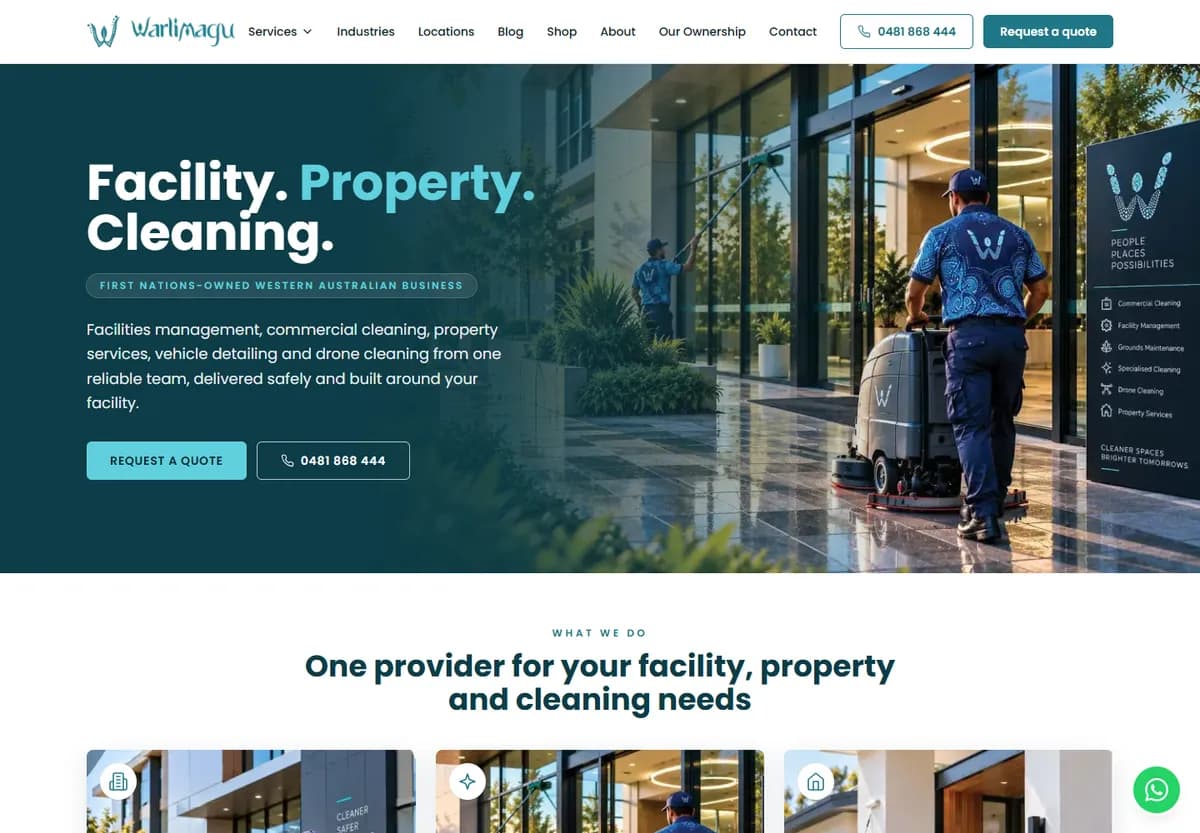
| Xavis Cleaning | Warlimagu | |
|---|---|---|
| Who it is | Cleaning-services company in Perth | Aboriginal-owned facilities, property and cleaning services business in Western Australia |
| Main heading | Names its base, its city and its services | Names the three lines of business |
| Main action | “Check Prices and Availability”, plus “Book online” and “Call Us” in the header | “Request a quote”, plus a phone button |
| First question in the form | What do you need help with? (one of seven services) | What do you need help with? (choose all that apply) |
| Form length | Service, extra details, contact details | Five steps, which it says take about two minutes |
| How it covers places | Areas served list, linking to all areas | Locations section naming Karratha, Port Hedland, Newman and Perth |
| Other navigation | Services, Areas, Guides, About, Contact | Services, Industries, Locations, Blog, Shop, About, Our Ownership, Contact |
The differences follow from the buyer. Someone moving out of a Perth rental wants to know the price and whether you can come on Friday. Someone responsible for facilities at several sites wants to know whether you cover those sites and that kind of work, so a form with room for more than one service makes more sense.
The parts that do the work
A heading that answers “can you help me?”
Xavis’s main heading says where the company is based, that it covers all of Perth, and that it does office, home and end-of-lease cleaning. A visitor knows in a few seconds whether they are in the right place, and the same words help search engines understand the page. Slogans can’t do either job.
A page for each service
Vacate, builders, window, carpet, commercial, upholstery, regular, office and strata cleaning are separate searches from different people, with different worries. Each deserves its own page saying what’s included, how the job works and what the customer needs to do. It’s also where a visitor from search will usually land, so each one needs the same route to a quote as the home page.
One action, repeated
Both sites pick one main action and repeat it: in the header, the first screen and the closing section. Warlimagu’s “Request a quote” appears in the header, hero, closing section and footer, always with the phone number beside it. Some people want to talk, so give them the choice without making them hunt for it. Tap-to-call on a phone is a basic requirement.
A form that starts with an easy question
Both forms open with “What do you need help with?” rather than asking for a name and email. That question is easy, it’s obviously useful, and it lets the next questions fit the job. Keep the questions that change your price: property type and size, frequency, and when the job needs doing. Drop anything that you would ask on the phone anyway.
Proof near the decision
Put the reasons to trust you close to the button. Xavis lists fixed-price quotes, insured specialists and same or next-day visits on its home page. Use only what you can stand behind. Commercial buyers will ask for insurance details, so say how to get them.
The part nobody sees: where the lead goes
A website can look perfect and still lose work if the enquiry disappears. Forms fail quietly: an email address changes, a message lands in spam, a plugin update breaks something. On these builds, enquiries are captured and can be exported as well as emailed, so a lost email doesn’t mean a lost lead.
Whoever builds yours, ask for these:
- a stored copy of every enquiry, separate from email
- a way to export them, so they aren’t trapped in the website
- an email to whoever actually answers quotes, including a shared address if more than one person does
- spam protection that doesn’t put a puzzle in front of a customer on a phone
- a test submission after every significant change
- a confirmation screen saying what happens next and when
Then count them. With Analytics recording each form submission and phone tap, you can tell which services and areas bring in enquiries, and stop guessing where to put your effort.
Getting found
For a local cleaner, a lot of the work happens outside the website, in the Google Business Profile, reviews and consistent details. Our local SEO checklist covers the setup in order. Speed matters too, because a quote request often starts on a phone, on mobile data. Our benchmark of service-business websites includes five cleaning companies, and how fast your site should be sets out the targets.
On the platform question, read Next.js or WordPress. Both of these sites use Next.js, but a well-run WordPress site can do this job too. What matters is the structure described on this page.
A short checklist
- Open the site on your phone. Can you tell what you do and where within five seconds?
- Does every service have its own page, with a route to a quote?
- Are the areas you want work from clearly named?
- Is the phone number one tap away on every page?
- Submit your own form. Did it reach you? Could you find it again without the email?
- Is it clear what happens after someone asks for a quote, and when?
- Can you see how many enquiries came from each page last month?
The two sites described here
Next.js lead-generation website for a Perth cleaning-services company: quote capture with export and email, Google Business Profile, GA4 and Search Console, ongoing local SEO.
- Sector
- Cleaning & facility services
- Region
- Australia
- Stack
- Next.js
- Engagement
- Website build and ongoing SEO
An Aboriginal-owned facilities, property and cleaning services business in Western Australia. Next.js website: enquiry capture with export and email, Google Business Profile, GA4 and Search Console, ongoing local SEO.
- Sector
- Cleaning & facility services
- Region
- Australia
- Stack
- Next.js
- Engagement
- Website build and ongoing SEO
Questions
Should a cleaning company show prices on its website?
It depends on the work. A standard home or end-of-lease clean is easy to compare, so a visitor expects at least a route to a price. A commercial contract depends on the site and the frequency, so a quote form makes more sense. Xavis Cleaning uses “Check Prices and Availability” as its main button; Warlimagu uses “Request a quote”.
How many fields should a quote form have?
As few as let you reply usefully, and no fewer. Splitting a longer form into short steps, starting with what the customer needs, is often better than cutting the questions you really need answered. Test the form on your own phone before deciding.
Do I need a separate page for every suburb?
Only where you really work there and have something specific to say. A set of pages that differ only by suburb name is exactly what Google’s spam policies warn against. Start with the areas you most want work from.
How much does a cleaning-company website cost with you?
We don’t publish a fixed price for these builds, because it depends on the number of services and areas and on what the quote flow has to do. Send us your list and we will give you a figure.
More on service-business websites
- Core Web Vitals benchmark of service-business websitesLighthouse tests we ran ourselves on 25 sites in five categories, with the method.
- How fast should a small-business website be?The targets that matter, and what our test sample actually reached.
- Next.js or WordPress for a service-business website?We build and look after both. How to choose by who will run the site.
- Local SEO setup checklist for a new websiteWhat to set up before launch, in the first week and in the first month.
Want a site built around quote requests?
Send your services and the areas you cover. We will tell you what we would build first and what it would cost.
We reply within one business day (IST).